

Table of Contents
- What Makes Everyday Apparel Durable
- Best Fabrics for Durable Clothing
- How to Tell If Clothes Are Good Quality
- Essential Wardrobe Staples That Last
- Cost Per Wear: Why Investment Pieces Make Sense
- How to Care for Clothes So They Last Longer
- Building a Versatile, Durable Wardrobe
- Frequently Asked Questions
Last Updated: October 8, 2026
What Makes Everyday Apparel Durable
Durability isn't just about how long a piece lasts. It's about how well it holds up to real life, the washing, wearing, and movement that happen every single day. At Light and Salt Boutique, we focus on apparel that survives the chaos of busy schedules while staying vibrant and comfortable.
Durable everyday apparel depends on three core factors: the quality of the fabric itself, how the garment is constructed, and how well you care for it. A shirt made from cheap polyester might feel soft initially, but it'll pill after a few washes. A well-made piece from quality materials can last years.
The difference comes down to fiber strength, seam integrity, and how the fabric is finished. When you invest in pieces built to last, you're actually saving money over time because you're not replacing items constantly. This is the philosophy behind choosing durable everyday apparel for women, quality over quantity.
Most people think durability means stiff or uncomfortable. That's wrong. The best everyday pieces feel amazing to wear while standing up to washing, stretching, and regular use. You shouldn't have to choose between comfort and longevity.
Best Fabrics for Durable Clothing
Durability starts at the fiber level. Two shirts can look identical on a rack and behave completely differently after twenty washes because of three variables: fiber length, fiber twist, and how the yarn is woven or knit. Understanding those variables is what separates a piece you keep for years from one you replace every season.
Fiber Length: The Variable Nobody Talks About
Cotton fibers are graded partly by staple length, how long each individual fiber is. Long-staple and extra-long-staple cottons (Pima, Supima, Egyptian) have fibers roughly 1.25 to 1.5 inches long, versus roughly 0.5 to 0.75 inches for ordinary upland cotton. Longer fibers mean more points of contact when the yarn is spun, so fewer fiber ends work their way to the surface and pill. That is the mechanical reason long-staple cotton resists pilling better than short-staple cotton, not marketing.
Ring-spun vs. open-end yarn: Ring spinning draws and twists fibers more tightly and produces a smoother, stronger yarn. Open-end (rotor) spinning is faster and cheaper but produces a hairier, weaker yarn that pills sooner. When a label says "ring-spun," you are paying for a real mechanical difference, not a buzzword.
GSM and Fabric Weight: How to Read the Numbers
Fabric weight is the single fastest durability filter you can apply. It is expressed two ways:
- oz/yd² (ounces per square yard), the standard on most U.S. apparel spec sheets
- GSM (grams per square meter), common on imported and technical garments
Rough conversion: 1 oz/yd² ≈ 33.9 GSM. So a 6.1 oz/yd² tee is roughly 207 GSM.
| Category | oz/yd² | GSM | Typical use |
|---|---|---|---|
| Lightweight | under 5 | under 170 | Summer tees, undershirts, thin fast |
| Midweight | 5-7 | 170-237 | Everyday tees, most durable basics |
| Heavyweight | over 7 | over 237 | Workwear, structured tees, long-lived staples |
A 4 oz/yd² tee will develop thin spots and holes faster than a 6.5 oz/yd² tee under the same wash cycle, because there is simply less fiber mass per square inch to absorb abrasion. Heavier is not automatically better, a 9 oz/yd² tee can feel board-stiff and get worn less, which defeats the purpose. Midweight is the sweet spot for everyday wear.
Weave and Knit Structure
Weight alone does not determine durability. Structure matters just as much:
- Single jersey knit, the standard t-shirt knit. Stretchy, comfortable, but curls at the edges and can distort.
- Interlock knit, two interlocked jersey layers. More stable, less curl, holds shape better over time.
- Twill weave, diagonal weave used in denim and chinos. Dense and abrasion-resistant.
- Plain weave, simple over-under. Lightweight but the least abrasion-resistant of the wovens.
- Herringbone and dobby, textured weaves that add density without much added weight.
A quick density test: hold the fabric up to a bright window or lamp. If you can clearly see the outline of your hand through it, the weave or knit is loose and will likely pill and tear sooner. If light passes through but you cannot resolve shapes, density is reasonable.
Natural Fibers, Ranked for Everyday Durability
- Wool (especially merino and worsted wool), naturally crimped fibers interlock, resist odor, and recover shape. Best-in-class for sweaters and suiting. Downsides: cost, moth risk, and it needs careful washing.
- Linen, flax fibers are among the strongest natural fibers and get softer with every wash. Wrinkles heavily; best for warm-weather pieces where that is acceptable.
- Long-staple cotton, the workhorse. Breathable, washable, and durable when ring-spun and midweight or heavier.
- Regular upland cotton, fine for light use, but pills and thins faster than long-staple.
- Silk, strong for its weight but sensitive to sunlight, sweat, and harsh detergent. Not an everyday durability pick.
Synthetics and Blends: When They Help, When They Hurt
- Polyester, strong and abrasion-resistant on its own, but pills when blended into cheap cotton and traps odor. Recycled polyester behaves similarly.
- Nylon, the toughest common synthetic; excellent in small percentages (2-5%) added to wool or cotton for reinforcement.
- Spandex (elastane), adds stretch and shape recovery, but degrades with heat and chlorine. Keep it under about 5% for everyday pieces; higher percentages shorten lifespan.
- Modal, lyocell (Tencel), and viscose, semi-synthetics from wood pulp. Lyocell is strong when wet and resists pilling well; viscose is weaker and prone to stretching out.
A blend is not automatically worse than a pure fiber. A 95% cotton / 5% spandex tee often outlasts a 100% cotton tee because the spandex helps the garment recover its shape after washing. The failure mode to avoid is a high-polyester blend marketed as "soft cotton feel", those tend to pill within a few months.
Putting It Together: A Quick Reference
A durable everyday tee, for example, typically looks like this on a spec sheet: 100% ring-spun cotton, 6.0-6.5 oz/yd² (roughly 200-220 GSM), single jersey or interlock knit, garment-dyed or reactive-dyed. A durable everyday pant: cotton or cotton-blend twill, 8-12 oz/yd², with 1-3% spandex for recovery. A durable sweater: wool or wool-blend, worsted or merino, with ribbed cuffs and hem to hold shape.
None of those numbers are exotic. They are simply the ones most product pages omit, which is exactly why reading for them gives you an edge over shoppers who only look at the photo and the price.
How to Tell If Clothes Are Good Quality
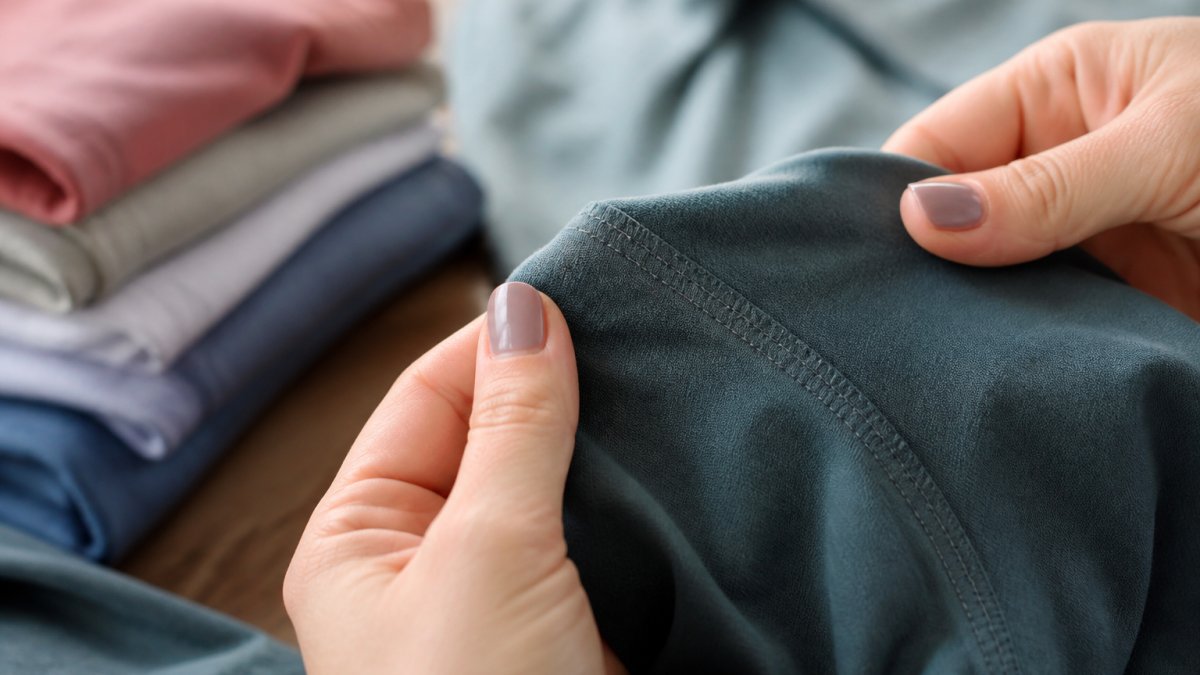
Quality assessment is a skill, not a vibe. The goal is to identify the specific places where garments fail and check them in under two minutes, whether you are holding the item in a store or reading a product page online.
Where Garments Actually Fail
Most clothing does not wear out evenly. It fails at predictable stress points, in this rough order of frequency:
- Underarm and side seams, the highest-movement, highest-friction zone on any top.
- Shoulder seams, bear the weight of the garment and any bag strap.
- Crotch and inner thigh, the abrasion zone on pants and jeans.
- Button and buttonhole attachment, the most common single-point failure on shirts.
- Zipper tape and slider, fails before the fabric does on jackets and dresses.
- Hem and cuff edges, where fabric meets the world.
If you only have thirty seconds with a garment, spend them on numbers 1, 2, and 4.
Seam Construction: What to Look For
Seam type tells you how the manufacturer expects the garment to be used.
- Single-needle lockstitch, the baseline. Fine for low-stress seams, weak under tension.
- Double-needle lockstitch, two parallel stitch rows. Standard on quality tees and denim. Distributes stress across two lines of thread.
- Flat-felled seam, folded and stitched so raw edges are enclosed. Found on jeans and workwear. Very strong, resists fraying.
- French seam, raw edges enclosed inside a folded seam. Common on fine shirts and lightweight wovens. Clean finish, moderate strength.
- Overlock (serged) seam, fast and cheap. Fine for knits, weak on wovens under tension.
- Flatlock seam, used on activewear and some knits. Lies flat, stretches with the fabric.
Stitch density matters too. Quality garments typically run 10-12 stitches per inch on structural seams. If you can see daylight between individual stitches, the density is too low and the seam will pull apart under stress.
Thread type: Look for 100% polyester or cotton-wrapped polyester thread. All-cotton thread is weaker and breaks down faster. If the thread color does not match the fabric, that is often a sign of a rushed production run.
The Stress-Point Checklist
Run this in order. It takes about ninety seconds in a store.
1. Underarm and side seam tug. Grip the fabric on either side of the underarm seam and pull gently apart. The seam should not gap or show the stitch line separating. Repeat at the side seam mid-torso.
2. Shoulder seam tug. Hold the shoulder seam between both hands and pull. On a quality tee or blouse, the seam stays flat. On a cheap one, you will see the fabric ripple and the stitches strain.
3. Button attachment. Buttons should be sewn with a minimum of four holes and cross-stitched, not just looped. Tug each button firmly. If it wiggles more than a millimeter or two, it will come off. Check the buttonhole: it should be cleanly cut with no loose threads and should hold the button snugly without strain.
4. Zipper test. Zip the zipper fully up and down three times. The slider should move smoothly without catching. Look at the zipper tape, it should be firmly stitched to the fabric with no puckering. Metal zippers outlast plastic; YKK-brand zippers are the industry benchmark for reliability.
5. Hem and cuff check. Hems should be double-folded and stitched, not single-folded with a raw edge. On knits, look for a cover-stitched hem (two parallel rows visible on the outside).
6. Fabric recovery test. Stretch a section of the fabric and release. It should snap back to shape within a second. Slow recovery means the knit or weave will bag out at the elbows and knees.
7. Pilling rub. Rub the fabric briskly with your thumb for five seconds. If pills form immediately, the fiber staple is short or the yarn is loosely spun.
8. Dye transfer. Rub a white tissue or your finger across the fabric. If color transfers, the dye is poorly fixed and will fade unevenly.
Reading Construction Online
When you cannot touch the garment, the product page and the label photo are your only evidence. Here is what to look for:
Unisex Garment-Dyed T-shirt-Dolphins →
- Fiber content with percentages. "100% cotton" or "95% cotton / 5% spandex" is a real spec. "Cotton blend" with no percentages is a red flag.
- Fabric weight in oz/yd² or GSM. If the brand publishes it, they are confident in the fabric. If they hide it, assume lightweight.
- Stitch type mentioned in the description. "Double-needle stitched" or "flat-felled seams" are specific claims. "Premium construction" is not.
- Zoomed-in photos of seams, hems, and buttons. A brand that shows you the stitching is usually proud of it.
- Care label photo. A garment that requires cold wash and low-heat dry is often a garment built to last; one that says "dry clean only" for an everyday tee is a warning sign.
- Return policy and reviews mentioning shrinkage, pilling, or seam failure. Search reviews for those three words specifically.
Common Construction Red Flags
- Loose or dangling threads at seams and hems
- Buttons sewn with only two holes or a single loop of thread
- Zippers that catch or feel gritty when zipped
- Hems that curl immediately on a knit
- Prints that feel like a plastic sheet on top of the fabric (they will crack)
- Asymmetric stitching, one sleeve hem wider than the other
- A care label that contradicts the product description
None of these checks require expertise. They require knowing where to look. Once you have run the checklist a few times, you will start to read a garment the way a mechanic reads an engine, quickly, and with confidence in what you are seeing.
Essential Wardrobe Staples That Last
Building a durable everyday apparel foundation means choosing pieces that work together and withstand constant rotation. These staples form the backbone of a versatile wardrobe:
Quality basics:
- Plain crew-neck t-shirts in neutral colors
- Long-sleeve tees for layering and cooler months
- Well-fitting jeans in classic washes
- Simple cardigans or sweaters
- Plain button-down shirts
- Neutral pants in cotton or cotton blends
Why these matter: These pieces get worn constantly. They need to survive weekly washing and maintain their shape. When you choose quality basics, you're investing in pieces you'll wear hundreds of times.
The Sunflower & Butterfly Long Sleeve Tee works as both a statement piece and a practical layering option. Its garment-dyed construction and quality stitching mean it transitions from casual weekends to layered looks without losing its integrity.

Avoid trendy basics that use cheap construction. A poorly made t-shirt might be cheaper upfront, but you'll replace it twice while a quality piece lasts years. This is the essence of cost-per-wear thinking.
Cost Per Wear: Why Investment Pieces Make Sense
Cost per wear is simple math that changes how you think about clothing prices. Divide the price of a garment by how many times you'll wear it.
Example calculation:
- A $25 fast-fashion shirt worn 10 times = $2.50 per wear
- A $45 quality shirt worn 100 times = $0.45 per wear
The quality piece is actually cheaper per wear, even though it costs more upfront.
This framework helps you see past the sticker price. A $45 piece that lasts 2-3 years and gets worn regularly beats a $25 piece that falls apart in 6 months. You're not paying more, you're paying smarter.
How to calculate for your own purchases:
- Estimate how many times you'll wear the piece in a year
- Multiply by how many years you expect it to last
- Divide the price by that total number of wears
- Compare across options
When you think about durable everyday apparel this way, investment pieces become obvious choices. The Unisex Garment-Dyed T-shirt at $22.99 worn 50+ times per year for 2+ years works out to less than $0.23 per wear.

How to Care for Clothes So They Last Longer
Washing and Drying Best Practices
How you wash clothes determines how long they last. The right techniques protect fabric integrity and prevent fading.
Washing guidelines:
- Use cold water for colored garments (prevents fading)
- Wash inside-out to protect prints and reduce pilling
- Use gentle cycles for delicate fabrics
- Avoid overloading the machine (clothes need room to move)
- Use mild detergent and skip fabric softener (it breaks down fibers)
- Don't bleach or use harsh chemicals
- Wash similar colors together
Drying methods:
- Air-dry whenever possible (extends garment life significantly)
- If using a dryer, use low heat settings
- Remove items promptly to prevent wrinkles and mildew
- Hang delicate pieces or those with prints to dry
The care instructions on your garment aren't suggestions, they're requirements for longevity. The Unisex Garment-Dyed T-shirt recommends cold-water washing and low-heat drying, which preserves both the fabric and the garment-dyed color.

Storage and Seasonal Rotation
How you store clothes affects their lifespan. Proper storage prevents damage and keeps pieces fresh.
Storage best practices:
- Fold knits to prevent stretching (hangers can distort shoulders)
- Hang woven pieces to prevent wrinkles
- Use wooden hangers (wire and plastic can damage shoulders)
- Store in cool, dry places away from direct sunlight
- Use cedar blocks or lavender sachets to prevent moths
- Ensure adequate air circulation to prevent mildew
- Don't store damp items
Seasonal rotation: Putting away off-season clothes gives everyday pieces a break. Rotating your wardrobe extends the life of each piece because they're not being worn constantly. A t-shirt worn 3 times per week lasts longer than one worn 7 times per week.
Building a Versatile, Durable Wardrobe
A versatile, durable wardrobe isn't about having lots of clothes. It's about choosing pieces that work together and last through years of wear.
Start with a capsule approach:
- Choose a color palette (neutrals plus 2-3 accent colors)
- Build around quality basics
- Add layering pieces
- Include one or two statement pieces for personality
The versatility principle: Each piece should work with at least 5 others in your wardrobe. If you buy something that only matches one outfit, it won't get enough wear to justify the investment.
Light and Salt Boutique's collection of vibrant, feel-good apparel makes it easy to build a wardrobe that sparks optimism while maintaining durability. Pieces like the Sunflower & Butterfly Long Sleeve Tee work as standalone statements and layering pieces, maximizing their versatility and wear frequency.
Quality rotation strategy:
- Wear pieces in rotation (don't wear the same shirt 5 days straight)
- This gives fabrics time to recover between wears
- Fabrics actually last longer when they're not worn constantly
- A 7-day rotation means each piece is worn once per week
When you build thoughtfully around durable everyday apparel, you end up with fewer pieces that you actually wear, rather than a closet full of things you never touch.
Choosing durable everyday apparel for women comes down to understanding fabrics, recognizing quality construction, and thinking strategically about cost per wear. When you focus on pieces built to last, you're investing in a wardrobe that supports your life without constant replacement. Light and Salt Boutique specializes in vibrant, high-quality pieces designed to deliver both comfort and longevity. Our garment-dyed cotton tees feature double-needle stitching, heavyweight fabric, and construction details that stand up to real life. Shop now and build a wardrobe that celebrates both durability and joy.
Frequently Asked Questions
What fabrics last the longest for everyday clothing?
Ring-spun cotton, linen, and cotton-blend fabrics typically offer the best longevity for everyday wear. Heavyweight fabrics (6.1 oz/yd² or higher) resist wear better than lightweight options. Garment-dyed cotton, which is dyed after construction, tends to hold color and softness longer than piece-dyed alternatives. Natural fibers with proper care can last years, while synthetic blends may show pilling or fading sooner. Look for pre-shrunk fabrics to avoid fit changes after washing.
How can you tell if women's clothing is well made?
Examine the seams first: quality garments have straight, tight stitching with no loose threads. Check for double-needle stitching on stress points like hems and armholes. Look at the fabric itself, it should feel substantial and smooth without pilling. Inspect labels for fiber content and weight (measured in oz/yd²). Quality pieces often feature reinforced neck tape, sewn-in labels, and seams that sit flat. Avoid loose buttonholes, uneven hems, or fabric that feels thin or flimsy.
How do you make everyday clothes last longer?
Wash in cold water (no hotter than 30°C/90°F) and tumble dry on low heat to prevent shrinkage and fading. Turn garments inside out before washing to protect prints and colors. Avoid bleach and dry cleaning unless the care label specifies it. Store clothes properly by rotating seasonal pieces and using gentle hangers. Address small issues immediately, repair loose seams or missing buttons before they worsen. Limit washing frequency by spot-cleaning minor stains and airing out garments between wears.
Is cost per wear a good way to evaluate clothing purchases?
Yes, cost per wear helps justify investment pieces by spreading their cost across actual use. A $45 garment worn 100 times costs $0.45 per wear, while a $20 piece worn 10 times costs $2 per wear. This framework encourages buying versatile, durable items that transition across seasons and occasions. Focus on pieces that match your existing wardrobe and suit your lifestyle. Quality fabrics, construction, and timeless design increase the number of wears you'll get, making higher-priced items often better long-term value.